Thursday, August 13, 2009

Knoxville

First off let me apologize for these pictures, they are from my pre-digital days. I scanned in these few pictures to show a bit of what's around Knoxville.

Most sites dealing with the siege of Knoxville are long gone. The city has grown and paved over the old battlefield. Maybe if it had been a bigger battle they would have worked to preserve a portion but the battle of Ft Sanders was pretty anti-climatic. Longstreet launched an attack that lasted about half an hour, losing about 800 men and inflicting a dozen.

The Knoxville Civil War round table has done a good job of producing a driving tour of the siege. I picked up my copy at the visitor's center downtown.

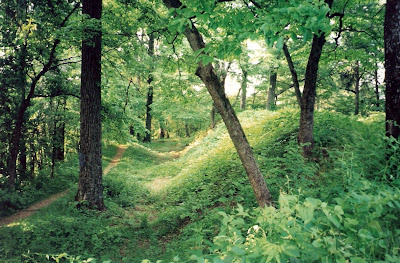
Fort Dickerson is located across the river from Knoxville and was one of the string of forts protecting the city.

Its relatively well preserved. It reminds me of Fort Granger in Murfreesboro, which I happened to have seen a few days before this.

General William Sanders died while leading the cavalry that screened Longstreet's advance on the city. Fort Sanders is named for him.

As far as the fort goes there are two monuments to mark the action there. No earthworks remain, its now mainly residential, with some college buildings.


This is the UDC monument.

And for the 79th New York.


In front of a church is a marker for Battery Wiltsie, a large earthwork protecting the city. As the marker indicates it was in roughly the center of the line of fortifications.

This is Bleak House, where Longstreet had his headquarters during the siege. Its open for tours though the ladies (UDC) running the place seemed reluctant to let Yankees inside. Once they learned that I like Lee the tour warmed up a great deal and was very nice. But in those first few minutes it appeared the tour would be, "This is the parlor, this is the kitchen, up the stairs is our museum, you have 10 minutes, go!" I recommend a visit, I'm just not sure I'd say you're from Massachusetts and your hero is Sherman, that might get you thrown out.

On the other end of the city is the Mabry-Hazen House. Joseph Alexander Mabry Jr outfitted a Confederate regiment at the beginning of the war. Its another nice house to visit, its hostess was a lot more gracious from the start than the ladies at Bleak House. Interestingly we visited Bleak House second and learned that there was some sort of tiff between them and Mabry-Hazen. I forget now what it was but I think Mabry later switched his allegiance to the Union. That his earlier donation to the Confederacy was more business related than out of devotion to the cause. I might not be remembering it correctly but I think that was the sin the ladies at Bleak House were upset about. Apparently in some circles Knoxville is still a divided city.

And no battlefield visit is complete without seeing a cemetery. This is the national cemetery.

Tuesday, August 11, 2009

Galena

In Galena, Illinois, is a house that Grant hardly ever lived in. But the town gave it to him as a gift at the end of the Civil War. He was there briefly before becoming President and would occasionally return. The house is now open to the public and is decorated as if Grant lived there which is kinda funny because he was hardly ever there. In any respect its a neat house to tour and the town of Galena is also quite a nice place to visit. I'd gladly return.

Here is the house. Unfortunately my pictures from inside didn't turn out well so I have none to share.

Out front is a monument to Grant's wife, Julia Dent Grant.

Nearby is a park, Grant Park, with a statue of Grant.


The park also has the Jo Davies County Civil War monument.
The photo is a little dark but you can see an indentation on the breech where an enemy artillery round struck the cannon.
The names of all Jo Davies County's soldiers is inscribed on the monument.

There are also other cannons around the park. Having Grant as a citizen of your town insured you'd get the best souvenirs. This cannon fired the first rifled cannon fired in combat on the American continent. It was among the guns that fired on Fort Sumter to start the war.

I included the picture of the plaque so you could read for yourself this astonishing fact.

This cannon was on the Spanish steamer Vizcaya during the Battle of Santiago Bay, 3 July 1898. The Spanish fleet was destroyed at the battle, the Vizcaya was blown up and this cannon was later sent to Galena as its prize.

For its World War 1 prize the citizens of Galena asked for an airship or submarine. Apparently being Grant's old town had lost some pull as they received this 1913 Krupp Howitzer. Still a fine piece but not quite the same as a submarine.
This is the main street of Galena. Now its mostly a shopping area. There was a pretty neat old book store but the prices were out of my range.

The teddy bear shop behind the red van was the location of the leather goods store that Grant worked in on the eve of the Civil War. He had failed at everything else he had tried and had come home to work in the family tannery, a job he hated. You can see the plaque for this historic spot on the wall just to the left of the street lamp.

There are many such plaques along this main street. Quite a few have to do with Grant or other Civil War era personalities.
I also went through the county museum which sits on the steep hill above the main street. It was neat, but once again no pictures turned out well enough to share here. The Civil War section is pretty extensive due to the Grant connection.
Grant's political sponsor, Elihu B. Washburne's house is also preserved. I believe the brochure said there were only tours during the summer months.

Monday, August 10, 2009

Symposium update

As many of you know I am involved (my wife would say heavily involved) in the Rocky Mountain Civil War symposium. I've been doing a bunch of stuff for that event lately and I hate to jinx myself but things seem to be going good, I think we're ahead of where we were when we did our first one in May 2008.

Its about 8 weeks away and I'm excited for the event to come now. I mean that in the sense that I think we are on schedule to have everything done in time. There might by glitches and problems that arise but I think we're better able to handle them now than we were our first time around. This time I'm not worried about finishing everything in only 8 weeks, I'm anxious for us to get down to 8 days to go. I have projects to do for the event but nothing too horribly difficult or time consuming.

In fact things are progressing so well that about a month ago I felt like I had enough free time to start lining up speakers for 2010, and we have three commitments (I don't want to reveal names quite yet but I am excited for another great event).

I'm also excited for the event to come in the sense that I think its going to be a great day of presentations. I'm anxious to see all our hard work come off but I'm also anxious to sit in the crowd and hear five great speakers.

Russel H. Beatie will provide an overview of the two campaigns. Specifically he will focus on the corps commanders and how they performed in both campaigns. Beatie is working on a multi volume history of the Army of the Potomac. I regret to say I don't own any of the books but I'm skimmed through them at the library and its a truly impressive series. The third book takes us up to May 1862, I can only imagine how long the series will be to cover the army's entire existence.

Stephen Recker will talk about the final phase of fighting at Antietam. He has titled his talk "IX Corps Final Attack: The Pickett's Charge of Antietam." Recker is the founder of the Antietam guide association, similar to the Gettysburg guides. He is also the creator of Virtual Gettysburg, a critically acclaimed interactive Civil War battlefield tour, and its follow-up, Virtual Antietam, which will be released next year.

Bradley M. Gottfried will discuss the other invasion by Lee that culminated at the small Pennsylvania town of Gettysburg. I became a fan of Gottfried's work with his Brigades of Gettysburg book. I also love the map book series he has started, with volumes on Gettysburg and First Bull Run.

I had a relative in the Iron Brigade, plus with all my family from Wisconsin its natural to have an affinity for the brigade. One of the foremost authorities on the Iron Brigade is Lance J. Herdegen and he will explain its activities in the two campaigns in a program titled, "From The Cornfield to McPherson's Woods: The Iron Brigade at Antietam and Gettysburg." Unfortunately my relative was not in the brigade in time for either fight, he was drafted into the 6th Wisconsin in time for the '64 Overland Campaign. I have all of Herdegen's books because they are all Iron Brigade related.

The final presenter, Timothy B. Smith, is a repeat from last year. He was well liked and when it came time to find a presenter to talk about battlefield preservation his name came up since he is one of the leading historians on this subject. He has done two books already in this theme and has a third coming out very soon (maybe even in time for the symposium.)

The Rocky Mountain Civil War Roundtable will hold its annual symposium on October 2-3, 2009 at the Community College of Aurora, Colorado. On Friday October 2 we are having a social hour event. Admission is limited to 25 to keep it informal and comfortable for all. Saturday, October 3rd, is our main event. Tickets for Saturday only are $50, while tickets for both events are $57. To order tickets, please visit www.RockyMtnCivilWarRT.com/OrderTickets.htm. You can also reach the Round Table for tickets at 303-249-4336.

I've also included a link to our flyer and our program. The program has fuller presenter biographies.

Wednesday, August 5, 2009

Port Columbus

My primary reason to visit Columbus Georgia was to see Port Columbus, the National Civil War Naval museum. It was fantastic, as good as I had been led to believe. There are a ton of flags, dioramas and you can even walk onto two ships, the USS Hartford and the CSS Albemarle. The crown jewel is the CSS Jackson.

You can't walk onto the Monitor but they have a full size replica, complete with dents from its battle with the Merrimac.
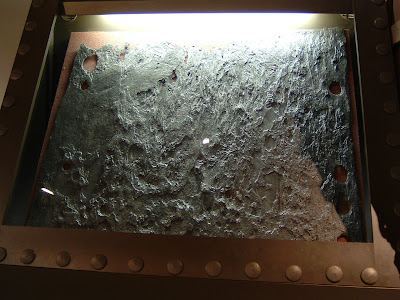
There is also a plate of iron from the Monitor.To the right is the USS Hartford.
On the Hartford:

The CSS Jackson was built in Columbus but when the city was captured in 1865 the ship war burned. In 1961 it was raised from the Chattahoochee River for the Centennial. The museum has built a framework that hangs over the remains so that you can see the outline of what the ship would have been.


Its a dark picture but these are the propellers.

One can also walk onto the CSS Albemarle. On the night of October 27, 1864 Union Lieutenant William Cushing led an expedition to destroy the ship as it sat at the dock at Plymouth, North Carolina. They were successful and Cushing earned the Thanks of Congress. There is a good book about him, Lincoln's Commando by Charles Van Doren (of quiz show fame).
The museum also has a scale model of the Albemarle.
One thing I really found interesting in the Albemarle display was that you got a good view of the layers of wood and iron plates.

Tuesday, August 4, 2009

Last Confederate General: John C. Vaughn and his East Tennessee Cavalry

The Last Confederate General: John C. Vaughn and his East Tennessee Cavalry
By Larry Gordon
Illustrated, maps, Index, 260 pp., 2009. Zenith Press, 400 First Avenue North, Suite 300, Minneapolis, MN, 55401, $27, plus shipping.


John Crawford Vaughn seems to have been just about everywhere during the war, although his military record was not that impressive. This mainly seems to be because he did not have as many resources to work with as the Union did.

Vaughn raised the 3rd Tennessee Infantry in Eastern Tennessee at the outbreak of the war. He led the regiment successfully in a small action at Little Creek, in what would be West Virginia. Then his men were part of the force that arrived from the Valley and helped turn the tide of First Manassas. His regiment would return to East Tennessee and win a battle near Cumberland Gap that earned Vaughn a promotion to brigadier general. After that he commanded a brigade of East Tennessee troops; the 60th, 61st and 62nd Tennessee.

This force was routed at Big Black River Bridge in the Vicksburg campaign, the 60th and 61st surrendering. After the siege he was sent back to East Tennessee and commanded forces that tried to deal with the local Union guerrillas. Then he suffered through the loss at Piedmont and while he received much blame at the time Gordon argues quite well that the Confederates were outgunned and outmanned and that Vaughn does not deserve much blame for what transpired. After a poor performance cooperating with DH Hill at Lynchburg Vaughn turned in a solid effort in Early’s invasion of Maryland.

After that campaign he was sent back to East Tennessee and suffered his worst loss at Morristown on October 28, 1864. There his lack of military training showed as he left a superior position, one that protected his flanks, for one that allowed the Union enough space to use their superior numbers to attack his flanks. Vaughn lost 4 cannon, 85 dead and 225 captured from his force of roughly 2000, no mention is made of how many wounded he had but it must have been at least a 100. The Union lost 8 killed and 18 wounded.

He performed better when he was leading smaller scale guerrilla style operations in East Tennessee, mostly with cavalry. He did earn a reputation as a brutal guerrilla fighter as his men gave no quarter when dealing with bushwhackers, though this was partly because they received no quarter either. At the end of the war he served for a few weeks as part of Jefferson Davis’ party traveling towards Texas. Vaughn is connected to some of the myths of the lost Confederate gold because of this but no one will ever know the truth of that story.

In many respects Vaughn was like most other Confederate generals. He was a capable leader who was neither exceptionally good nor bad at warfare. There is one part of Vaughn’s story that is unique; he was the only general on either side whose family was captured and imprisoned. In July 1864 they were arrested and sent to Jeffersonville, Indiana. The Vaughn women were released sometime in September but Vaughn’s father was kept in prison until the war was over.

I think Gordon did an admirable job with a tough figure. Vaughn was not a great general nor a really horrible general. He did a terrible job at Morristown and his defeats at Big black River Bridge and Piedmont were more the result of his commanders’ actions than anything he did. When he commanded small forces in small battles he was successful quite often. He did his best work in East Tennessee and has largely been lost to history. Most buffs have probably seen his name a time or two but do not know much about his whole story. Now they can learn more about this man. It’s not a great book, an instant classic, but it is a solid biography of a lesser known general.

This review appeared in the August issue of Civil War News

Thursday, July 30, 2009

National Infantry Museum at Fort Benning

I went to Columbus, Georgia, to see the naval museum but also went to the National Infantry Museum inside Fort Benning. Once you pass gate security it was a great museum, luckily I was traveling with a retired Staff Sergeant so the MPs didn't bother us much.

The museum covers the whole history of the US Army. There are more exhibits on World War II but that is mostly because of the size of the collection.

This diorama of the Battle of Monongahela is not Civil War related but I thought it was interesting.


This is the flag for the 39th Infantry, it is a post war flag as the 39th was not formed until 1866.


The notation for this flag stated that it was found on the battlefield of Gettysburg. Was it a regimental flag? Did it fly over a building in town? No other info on its origin was on the sign.

Another flag for a Colored Regiment, the number is not clear in my picture. But since its actually referred to as a "Colored" regiment I believe that this is of Civil War vintage.

My pictures of the other Civil War exhibits didn't turn out too well due to the reflection and glare off the display cases.
Outside is a tank park, which are always fun to wander through.


And a picture of Confederate General Henry L. Benning, for whom the fort is named. Benning lived most of his adult life in Columbus.

I thought the museum was neat and probably would visit it again if I was in the area but wouldn't make a special trip to see. Yesterday though I saw pictures of the museum on Lee White's facebook and it appears much different, he even called it the best museum he's been to. I guess I'll have to go check it out again to see all the changes.

Wednesday, July 29, 2009

Top Shiloh books

The folks over at the Shiloh discussion board are doing their own top Shiloh books, perhaps inspired by the recent Gettysburg blog carnival. Brett at TOWOC asked if I would be interested in participating and so here I am. Instead of a top 10 they went with a top 7.


1 Shiloh and the Western Campaign of 1862 by O. Edward Cunningham
I'd often run into references of this manuscript as the premier study of Shiloh. Eventually I got tired of hearing about it and got a copy of the dissertation thru interlibrary loan, and I made my own copy. A few years later Tim Smith and Gary Joiner edited the dissertation for the University of Tennessee Press so now we can all get our hands on this book. And it is a great book. My fault with the dissertation was a lack of maps but that has been fixed in the UT printing.

2 Battle of Shiloh and the Organizations Engaged by DW Reed
Reed was the first historian at Shiloh and this book is really the first history of the battle. Once again UT Press has made Shiloh easier to research as they recently reprinted this book. Copies of this book were included in most of the state monument commission books so it isn't too hard to find the text. But it is now much nicer to not worry about potentially damaging a 100 year old book. The text is a little dry as Reed was more concerned with laying out facts about troop movements than weaving an interesting anecdote filled story. Reed is also responsible for the cast iron tablets on the battlefield today.

3 Shiloh: The battle that Changed the Civil War by Larry Daniel
Until Cunningham's dissertation was finally published Daniel's book was my favorite of the three modern works on the battle. It doesn't have all the detail that Sword's book (see below) has but it places the battle in the context of the war better than Sword did.

4 Seeing the Elephant: Raw Recruits and the Battle of Shiloh by Joseph Allan Frank and George A. Reaves
Shiloh is one of the few battles that has large numbers of raw soldiers seeing combat for the first time. Even in other battles, like Perryville or Stones River, that feature many new troops there were also quite a few veterans in the army. In fact outside of Bull Run I'm not sure there is another battle that features so many fresh troops without a sizable veteran contingent. Frank and Reaves sifted through the archives at the park to describe the experience Shiloh's raw troops had. Its not a blow by blow account but is a wonderful way to get the feel for the soldiers' experience.

5 Untold Story of Shiloh by Tim Smith
In this volume Smith tries to fill in some of the gaps in the story of Shiloh. Some of this involves attacking the persistent myths, some of it is simply telling the stories that got shifted to the side.

6 Shiloh, Shells and Artillery Units by George Witham
I consult this book quite often when I need information on artillery units at Shiloh. It is not a narrative but more of an encyclopedia. For every unit at the battle Witham will say what type of cannon they had, how many men were there, how many casualties they suffered, list the officers and then usually have a portion of the Official Records to explain what they did at the battle. There are also many pictures of the different types of shells as well as many pictures of cannon on the field. Some batteries get better treatment as there was more information available for Witham to use, and some entries also include pictures of the men who served the guns.

7 Shiloh: Bloody April by Wiley Sword
I was really conflicted over which book to list, Sword's or James Lee McDonough's "Shiloh: In Hell Before Night." Both are very good but in different ways. McDonough provides a good overview and deals with the battle from the brigade level on up. Sword goes down to the regimental level. I went with Sword in this spot because I've probably consulted it more often than McDonough over the years.

There are many other great Shiloh books out there. I'm fond of:
This Great Battlefield of Shiloh by Tim Smith (focuses on the formation of the park up to 1933)
Shiloh: A Novel by Shelby Foote (a great book I end up reading once a year)
Shiloh and Corinth: Sentinels of Stone by Timothy Isbell
Eyewitnesses at the Battle of Shiloh by David Logsdon
War College Guide to the Battle of Shiloh by Jay Luvaas, Steven Bowman and Leonard Fullenkamp

I also am interested in reading The Shiloh Campaign edited by Steven Woodworth. Its a collection of essays on the campaign that was published earlier this year and I still have not picked up a copy (shame on me).

Monday, July 27, 2009

Four Mile House

As promised weeks ago, for Fourth of July I took the aide-de-camp to Four Mile House for their annual celebration. I knew he'd enjoy it as there are always a lot of activities for the kids, plus he would get to see Civil War soldiers and Abe Lincoln.

Four Mile House is located four miles from downtown Denver and was named Four Mile House back when there was no downtown Denver, it was just Denver (or Denver City on some old maps). I've heard that this house is where the remains of the Hungate family were deposited by the Indians after their brutal killing east of town. It seems odd for the Indians to bring the bodies in when they could have just left them on the prairie and not run the risk of another fight near town so I doubt that story. The Hungate Massacre (the family was not just killed but chopped up) is what brings the citizens of Denver to a fever pitch against the Indians in 1864 and precipitates the Sand Creek Massacre. Before I get some angry comments, I'm not saying it justifies it I'm simply pointing out what was happening that year that prompted Denver's citizens to raise a regiment to fight Indians and culminated in a sad incident at Sand Creek.

In any respect the grounds of Four Mile House are now tranquil and are filled with reenactors of all sorts. There were mountain men and Sioux Indians, blacksmiths and suffragettes, and Civil War soldiers and Abe Lincoln.
I didn't get a picture of Lincoln as my son was a little nervous and didn't want his picture taken with Old Abe. Later he was in the mood but Abe was not in his tent, must have been having lunch. Abe has a wonderful sense of humor. While we were talking with him a soldier asked him to move as we were sorta downrange of the artillery that was going to fire off soon. Lincoln told the crowd that they should move, but that he was less worried about cannons; it was the small guns, like a derringer, that he was more scared of. The joke passed right over the head of the crowd but I enjoyed a little chuckle.

There were also carriage rides, wood crafts, kids games and an old time kitchen display. We got to churn some butter and squeeze some lemonade. The apple peeler/corer/slicer was already out of apples but we got to see what the final result was. My son enjoyed it all. He thought the cannon and rifles were too loud but he loved watching the blacksmith, he got to make a wooden race car and he enjoyed the carriage ride too.

At this point he was hot and tired, plus he just didn't want a picture taken, but he humored me somewhat.

Monday, July 13, 2009

Hiatus

My mom is sick. I don't want to share specifics but sick enough that she'll spend the next week in the hospital. So my thoughts are not with the Civil War right now. I'll blog again when things are looking up and my mind can focus once again. Not sure when that'll be but I'll post here next Monday if its gonna be two weeks away from the blog.

Thursday, July 9, 2009

Missionary Ridge


The Story of a Regiment: Being a Narrative of the Service of the Second Regiment Minnesota Veteran Volunteer Infantry by Judson Bishop. Edited by Newell Chester.


If you've ever wondered just how exactly the Union army decided to continue the charge up Missionary Ridge instead of stopping at the first line, as they were ordered, this book solves the mystery.


The very first chapter, "The Mystery of Missionary Ridge Unraveled" the amazing story is told. Captain John Reed Beatty, aide-de-camp to Colonel Ferdinand Van Derveer had reached Company H of the 2nd Minnesota just after they took the first line of rifle pits. He saw that they could not stay there, they either had to retreat or go forward. So he ordered bugler Billings J. Sibley to sound the charge. He also made his old company (remarkably he had started the war as the first lieutenant of this company before joining Van Derveer's staff) promise not to tell anyone why the bugler had sounded the charge. Apparently Beatty had the presence of mind to make an attempt to protect himself from charges of "insubordination of a direct order" by eliciting that promise from his old comrades.


The men started the charge, the rest of the Union army soon followed their example and the ridge was won. The next day Sibley wrote his father but did not tell him of his historic part. Beatty never mentioned it in letters to his wife. The whole historic moment would have been lost except one comrade couldn't keep the secret forever. On May 9, 1916 Roswell Lyon Nason told the story to the Mankato Review. Beatty had died the previous month and Sibley had died three years earlier. Nason was the last surviving member and he thought it was his duty to reveal the story.


Why Beatty did not tell someone when he served on the Chickamauga Chattanooga battlefield commission in 1893 is unknown, by that time its doubtful anyone would have preferred charges against him. I bet if we looked at every regiment that made that charge we would find some similar stories. I looked through the three modern books on Chattanooga, by Wiley Sword, Peter Cozzens and James Lee McDonough, and found no reference to Beatty being responsible. I did find countless other counts of regiments or brigades that continued past the first line, were called back and then shortly thereafter went up anyway for a variety of reasons. Some essentially decided that it looked like everyone else was doing it, or about to do it, so they might as well go up too. Some received a message that said in effect that if you think you can take the ridge then go for it. I know Sheridan sent his aide to Granger to clarify the orders because some of his men had advanced and then returned. The aide came back with the message to the effect that they could charge but they'd better succeed, the gist being that if you do it no one will care why you did it but if you fail someone will face a court martial.

Nason tells a good story however there is certainly a fair amount of embellishment to the story. I think it is especially odd that Beatty did not share the story when he served on his state's monument commission for the park. It would have been a wonderful story to tell 30 years later. I'm sure it would have also set off a firestorm from other veterans saying that they started up the ridge before the 2nd Minnesota did, but it would have been a good story. Since Beatty never said a word to anyone I'm actually apt to believe he did not do what Nason claimed. I'm more likely to believe that Nason wanted one last moment of glory and telling this story as the last living survivor was a good time to do it.

Wednesday, July 8, 2009

Lincoln and the Decision for War by Russell McClintock

Awhile back a good friend asked me to make a list of pre-Civil War books, books that explore the growing conflict. I selected The Coming Fury by Bruce Catton, Uncle Tom's Cabin, Freehling's Road to Disunion: Secessionists Triumphant, Lincoln: President Elect by Holzer, Cry Havoc by Nelson Lankford, Lincoln and the Decision for War by McClintock, Outbreak of the Rebellion by Nicolay and Fires of Jubilee by Oates. This list was being used to create a display at the Barnes and Noble he works at so I kept the list to recently published books or things I was sure would still be in print. No sense saying a book last published in 1959 was a must have, they could not stock it.

For some books I also said what I knew of it, what period of time it covered or whatever else seemed important to tell. For McClintock’s Lincoln and the Decision for War I wrote that I had heard from several other sources that this was one of the better books to come out in 2008 but that I had not read it. A day or so later I finished Grierson’s memoirs (my review of which was posted here two days ago) and I remembered my own words on the book, so since I did not have anything lined up to read next I started McClintock’s book. I don’t think I’d say it was the best book of 2008 but I did enjoy it.

McClintock follows the various political factions in the North from Lincoln’s election through his call for volunteers following the firing on Fort Sumter. He does a good job of explaining how the various Republican factions came together to win the election and then how Lincoln had to hold them together until Inauguration Day when he could wield firmer control. He ran the very real risk of elements of his party working together with the Democrats for peace at any cost, which he certainly did not want.

He desired peace but there were certain things he would not waver on. The main thing he wouldn’t waver on was if any agreement was reached that made it seem he had to concede things to be allowed to be inaugurated. The Republicans had won an election fairly and if they now had to concede things it would be a backward step for democracy. The unhappy minority could not be allowed to dictate how things would happen, that would completely undermine the foundations of representative democracy. This prevented most forms of compromise from happening at all. This was also partly because the Democrats, mostly Southern Democrats, were not just happy with a promise of an extension of the Missouri Compromise Line, they wanted a much harsher fugitive slave law, or they wanted slavery protected in the Constitution, or some other promise that the Republicans could not agree to without abandoning the platform they ran on.

So how did Lincoln keep all these factions in line well enough that nothing was agreed upon that he could not live with? Through old fashioned party politics. He pressured state party leaders to keep their senators and representatives in line. He kept quiet enough that no one really knew what he was going to do, so they stuck to the party line to keep their own prospects bright. An example is that Lincoln kept his cabinet choices quiet much longer than he needed to partly because the various factions would not step out of line thinking it might cost their part of the party from a choice cabinet post when often the decision was already made. When the state party leader told them what was expected of them they mainly behaved because they didn’t want to mess up their faction’s, or their own, prospects.

McClintock does give President James Buchanan some praise, mainly by pointing out that it really was a very tricky situation and there was very little Buchanan could really do alone after the election. If Lincoln wanted to wait til he was president to make things happen, to work on a peaceful compromise there really was little Buchanan could do with the make up in Congress he faced then. There is one place that McClintock really points out a weak side of Buchanan, but doesn’t skewer him as savagely as he could have. Buchanan’s attorney general, Jeremiah S. Black, told him that he could not fill the vacant posts in South Carolina, such as customs collector, unless the local federal officers requested assistance. Since all the federal officers resigned in South Carolina there was no one there to request assistance so Buchanan could not send anyone down there to fill the abandoned posts. This is just nonsense. Basically Black was saying that since all of South Carolina’s federal employees quit there could be no federal presence there anymore. If one man had stayed on the job then he could ask for help but if he didn’t there would be no new appointees sent to South Carolina. But in reality these men just switched their allegiance to South Carolina. The duties were still collected but the money went directly to the state and not the federal government. Black envisions a federal government so weak that any state anytime could just have its federal employees resign in mass and the federal government could do nothing about it. Buchanan accepts this opinion. McClintock should have skewered this opinion as idiotic. He doesn’t do that but he puts the facts out there well enough that the rest of us can see how silly Black’s opinion was and think less of Buchanan for accepting such an opinion.

Cry Havoc covered some of the same ground as McClintock, although the focus of Cry Havoc was from the inauguration to the opening shots. And I’m sure Holzer’s Lincoln: President Elect also covers similar ground. I enjoyed Cry Havoc and have recently started President Elect. I definitely think there is enough new in McClintock’s book to recommend it.

I've read a review of Holzer's book that says he challenges the commonly held belief that Lincoln did not do much during the secession winter. I think McClintock does a good job too of showing that Lincoln did much but it was behind the scenes. Keeping the various factions together was a big job plus he also had to deal with early office seekers and crafting his inaugural address. Perhaps though Holzer spends more time on Lincoln as McClintock's goal was more of what was happening in the North while the South started to secede. Lincoln is definitely part of that equation but McClintock spends quite a bit of time discussing aspects from all areas of the North.
From what I've read so far of President Elect my initial opinion is that Holzer is providing more details than McClintock did. McClintock would report that Lincoln went to Chicago and met with Hamblin to discuss cabinet possibilities. Holzer gives more details like who Lincoln traveled with, who else he met with, who he had dinner with, etc. And there is value in all that but on the other hand a wealth of details can sometimes draw the focus away from the message. If I could only keep one of the two books I'm not sure which one I'd keep, not yet.

A slightly different version of this review appears in the July issue of Civil War News.

Tuesday, July 7, 2009

Gettysburg books

Brett at TOCWOC, has tallied the results from the joint blogging effort I recently participated in concerning the top Gettysburg books. Click here to see the full tally, but here is a shortened version of the top 10:
1 Gettysburg Campaign: Study in Command by Edwin B Coddington
2 Gettysburg - The Second Day by Harry W. Phanz
3 Retreat from Gettysburg by Kent Masterson Brown
4 (tie) Gettysburg: A Journey in Time by William A Frassanito
4 (tie) Killer Angels by Michael Shaara
6 Gettysburg July 1 by David Martin
7 Pickett's Charge in History and Memory by Carol Reardon
8 Plenty of Blame to Go Around by Eric Wittenberg and J. David Petruzzi
9 Pickett's Charge: The Last Attack at Gettysburg by Earl J. Hess
10 Gettysburg by Stephen Sears

I think the list is right on with one exception, I don't think two Pickett's Charge books should be in the top 10 but that's a minor quibble. I am surprised how highly Retreat from Gettysburg was ranked. Looking over my list again I'm shocked that I forgot to include Killer Angels in any fashion. That was the book that got me hooked on the Civil War and started all this craziness. I'm glad others remembered to include it so that it ended up in a tie for fourth.

Here's my list again for comparison:
1 Gettysburg Campaign: Study in Command by Edwin B Coddington
2 Gettysburg - The First Day by Harry W. Phanz
3 Maps of Gettysburg by Bradley M. Gottfried
4 Gettysburg: A Journey in Time by William A Frassanito
5 Gettysburg Day Two: A Study in Maps by John Imhof
6 Covered With Glory: 26th North Carolina at Gettysburg by Rod Gragg
7 In the Bloody Railroad Cut at Gettysburg by Lance J Herdegen and William JK Beaudot
8 Lee's Real Plan at Gettysburg by Troy D Harman
9 Retreat from Gettysburg by Kent Masterson Brown
10 Pickett's Charge by George R Stewart

This was a fun event and I hope we do something like it again in the future.

Monday, July 6, 2009

Benjamin H. Grierson’s Civil War Memoir

A Just and Righteous Cause: Benjamin H. Grierson’s Civil War Memoir
Edited by Bruce J. Dinges and Shirley A. Leckie.
This review appears in the July issue of Civil War News.

If you desire a highly detailed account of cavalry operations in Mississippi from the Union’s perspective this book is for you. For much of Grierson’s service he commanded the cavalry in the vicinity of Memphis, Tennessee which required him to conduct many raids and scouting operations in Mississippi. He provides a ton of details on what roads were taken, what time his units moved at, the order of march of the units and much more. He must have kept incredible notes during the war that he was later able to turn them into this memoir. He also later served in Alabama at the close of the war but there was very little fighting by that time.

Grierson of course is most well known for his raid through the entire length of Mississippi in April-May 1863. That raid is recounted here in amazing detail, down to the names of the plantations he stopped at, although some of this detail is provided by the editors. Since Grierson’s memoir has remained unpublished until now his addition to the story of the raid will improve our knowledge of that operation.

Grierson’s superiors thought highly of his skill conducting operations in the Memphis area. His combat record suffered because when he went on joint operations in the field he was often saddled with a less than stellar superior officer. William Sooy Smith and Samuel Sturgis were no match against Nathan Bedford Forrest no matter how good their cavalry was handled. Eventually Grierson would benefit from having AJ Smith lead the joint operations and they would then gain victories against Forrest in northern Mississippi.

As a memoir there are two things I especially liked about Grierson’s memoirs that is not standard among all other memoirs. First is that he shows very little ego, in fact sometimes he is so humble as to seem ridiculous. This is probably because the memoir was originally crafted for his family’s eyes only, although at the end of the book he does make it seem that his intention has expanded to include a much wider audience. His supreme humble moments tend to center on his musical talents. He showed musical aptitude at an early age and when just a young man became leader of his town’s band. He will later mention that he played the piano at a Southern plantation and the assembled crowd that he did a good job. Of course he did a good job, he was a musical teacher before the war, he was writing his own songs and he had learned how to play a large variety of instruments.

The second thing I liked about Grierson’s memoirs is that he doesn’t pull any punches when it comes to laying praise or blame for any action. One example I found refreshing was at the end of his chapter on the battle of Brice’s Crossroads. His commanding officer, Sturgis, was justly receiving a lot of blame for how the battle turned out. Sturgis sent Grierson a letter asking if he was to blame for the results of the battle. Sturgis probably was gathering information in case he had to face a court of inquiry or prevent one from being formed. Grierson wrote a letter back that the charges of drunkenness were false but that he did not know enough details of the orders Sturgis received to know if he was at fault for the battle. Grierson provides both letters in his text and then goes on to explain why he would send such a letter since his telling of the battle pointed out many things that Sturgis failed at. Basically Grierson says that at the time he knew that blasting his superior would reflect badly on himself plus he knew Sturgis would never have an important command again, which is true. Then Grierson recited all the ways Sturgis had performed badly and how he truly was to blame for the defeat. Reading why he wrote what he did in 1864 and something different twenty years later makes perfect sense.

The one drawback to this book is a lack of maps. There are only two maps in the entire book. One shows Illinois and the other shows Mississippi. The Mississippi map should have been more detailed. In addition his late war operations in Alabama are not visible on either map. And a map of the battlefield at Brice’s Crossroads would have been nice because he goes into great detail concerning troop dispositions there.

This is a well written memoir that while highlighting the talents of its author does not make it seem like he was the prime reason the Union was victorious, which does happen in some memoirs. If Grierson had just provided a nice memoir of his service that would be enough to recommend this book but he also provided a highly detailed account of his service. If someone wanted to learn details about the cavalry operations in Mississippi they would not have to compile it from the Official Records, they could use Grierson’s memoirs first and use the Official Records for additional information.

Saturday, July 4, 2009

Independence Day

I had a somewhat random thought last night. If the Confederacy had succeeded what day would Confederates celebrate as Independence Day? There was a lot of rhetoric about how they were continuing the work of Washington, Jefferson, etc so they probably would have had a 4th of July celebration but it seems odd for two countries to celebrate the same day for similar reasons. I think that eventually some other holiday would have become more prominent to Confederates. Would this have been the day that the peace treaty was signed, or when an armistice was declared, or the battlefield victory that made peace assured, or Jefferson Davis' inauguration, or the firing on Fort Sumter, or the first meeting in Montgomery, or the day South Carolina officially started the whole mess? My guess is that it would either be the Fort Sumter anniversary or whenever some battle secured peace.

I'll be celebrating Independence Day by taking my son to Four Mile House Park in Denver. They always do a pretty good Independence Day celebration. There will be a Civil War camp (infantry and artillery), Abe Lincoln (a pretty good local presenter), wagon rides and other fun stuff. Probably will also take him to a cemetery, he seems to like going through them with me. Then we'll go to my parents' house for some brats and burgers. We'll probably watch fireworks from our front yard like we did last year. I think the Rockies will also broadcast the stadium show, so we can watch that if there is not much locally to see. I should have some pictures to share Monday from Four Mile House.

Thursday, July 2, 2009

Top Gettysburg Books

After much hemming and hawing here are my top 10 Gettysburg books. First the list and then some commentary follows below.

1 Gettysburg Campaign: Study in Command by Edwin B Coddington
2 Gettysburg - The First Day by Harry W. Phanz
3 Maps of Gettysburg by Bradley M. Gottfried
4 Gettysburg: A Journey in Time by William A Frassanito
5 Gettysburg Day Two: A Study in Maps by John Imhof
6 Covered With Glory: 26th North Carolina at Gettysburg by Rod Gragg
7 In the Bloody Railroad Cut at Gettysburg by Lance J Herdegen and William JK Beaudot
8 Lee's Real Plan at Gettysburg by Troy D Harman
9 Retreat from Gettysburg by Kent Masterson Brown
10 Pickett's Charge by George R Stewart

I made my list as if I had to trim my Gettysburg section to only 10 books these are the ones I'd pick.

1 - Coddington's Gettysburg Campaign. This is the classic book on the battle. Recently Stephen Sears and Noah Andre Trudeau have done very good books but its hard to knock Coddington off his perch. I didn't put Sears or Trudeau on the top 10 because I didn't want to have the list clogged with similar books. If I had made my criteria only the top 10, regardless of similarity then I think Sears and Trudeau would have made the list.

2 - Phanz's Gettysburg - The First Day. It was hard to pick only one Phanz book. he has also done good work with "Gettysburg: The Second Day" and "Gettysburg: Culp's Hill & Cemetery Hill." But I have an affinity for the first day so I picked this volume. Once again if I was picking just a top 10 of all time I'd probably have all three of these books in the list (but the list would already be 60% done and there are plenty of other good books out there).

3 - Gottfried's Maps of Gettysburg. I love maps, can't live without them, can't have too many. This book is perfect. I'm glad to see that Savas is making this a series that will extend to many other battlefields.

4- Frassanito's Gettysburg: A Journey in Time. At first I thought this seemed pretty high to have a picture book, but its become a classic. I cannot think of any other picture book I'd put in the top 10 at all. David J. Eicher's "Gettysburg Battlefield" was good, but has its own issues/irregularities that I can't rate it in the top 10.

5 - Imhof's Gettysburg Day Two: A Study in Maps. I realize that's two map books in the top 5 but if you've ever seen Imhof's book you'd understand why. Of course Imhof's book is exceptionally rare, only 1500 copies printed. I know 1500 is a pretty healthy sized print run but when the book is being listed for $575 to $1300 online (and not autographed copies) it indicates that the demand is still out there. I've heard that copies have sold in the $400 range so the $575 isn't a crazy figure, its high but not so out of line to absurd. For whatever reason the publisher has no interest in printing a second edition.

6 - Gragg's Covered With Glory. This is the story of one of the hardest hit regiment's in the war. They have a horrific experience at Gettysburg getting into a tough scrap with the 24th Michigan on July 1st and then making the attack on the Angle on the 3rd. I couldn't read books with such a detailed focus all the time but do enjoy them. Gettysburg has more of this small story books than any other battle.

7 - Herdegen and Beaudot's In the Bloody Railroad Cut. Once again I picked a small scale book. This time the focus is the fighting in the railroad cut, of which the 6th Wisconsin played a huge role. My family is from Wisconsin and I had a relative in the 6th Wisconsin (though he enlisted post-Gettysburg) so I have an affinity for all things Iron Brigade. Herdegen has also come out with a new book on the Iron Brigade at Gettysburg. I haven't bought it yet but will. If we do this list next year that book may edge out this one.

8 - Harman's Lee's Real Plan. It seems like a few years ago we had a bunch of books come out that were titled Lee's Real Plan, or something similar. Harman's book makes the point that Lee could never have seen "The Copse of Trees" and instead was focused on Ziegler's Grove. I think he makes a ton of sense and proves his point. I think the title is overplaying it a bit too much but this book does somewhat shift our understanding of Lee's plan. Of course it means the whole thing was messed up as the attack makes its penetration south of Ziegler's but after all the other mistakes of the campaign one more isn't such a big deal.

9 - Brown's Retreat from Gettysburg. We've also been treated to a couple of books on the retreat from Gettysburg after it being widely ignored. I haven't read the book done by Wittenberg, Petruzzi and Nugent but have heard it is good too. One day I'll read it but for now I'll include Brown's on my list.

10 - Stewart's Pickett's Charge. Pickett's Charge is the iconic moment of Gettysburg. When I talk to average people they don't know about the Peach Orchard or Culp's Hill or Barlow's Knoll. But they will have heard about Pickett's Charge. How could I leave that moment off a top 10 Gettysburg list? I couldn't. The last spot was hard to pick as there were several good books I haven't mentioned but in the end I had to have Pickett's Charge here.

There are many other good Gettysburg books I have not mentioned. In addition to the other ones I listed in my notes above I'd also like to say that I enjoyed the following books (I guess I needed to do a top 25 list). In no particular order:

Brigades of Gettysburg by Bradley M. Gottfried
Pickett's Charge in History and Memory by Carol Reardon
Gettysburg Day Three by Jeffry D Wert
Pickett's Charge: Eyewitness Accounts edited by Richard Rollins
Lincoln at Gettysburg by Gary Wills
The First Day at Gettysburg edited by Gary W. Gallagher
The Second Day at Gettysburg edited by Gary W. Gallagher
The Third Day at Gettysburg and Beyond edited by Gary W. Gallagher
War College Guide to Gettysburg edited by Jay Luvaas & Harold W Nelson
Gettysburg's Bloody Wheatfield by Jay Jorgensen
North with Lee and Jackson: Lost Story of Gettysburg by James A. Kegel
Gettysburg by Lt Frank A Haskell & Col William C Oates
Battle of Gettysburg: The Official History by George R Large
Grappling with Death: Union 2nd Corps Hospital at Gettysburg by Roland R. Maust
35 Days to Gettysburg by Mark Nesbitt
Struggle for the Round Tops: Law's Alabama Brigade by Morris M Penny and J Gary Laine
The 19th Indiana Infantry at Gettysburg by William Thomas Venner
Days of Darkness: Gettysburg Civilians by William G Williams