I fear this post might be well behind the times but in case its not, I recently found out that that the University of Tennessee Press has put pdfs copies of the Betts' Chickamauga maps online. These maps were created when the battlefields of Chickamauga and Chattanooga were preserved. Henry Boynton was the first park historian and wrote the official battle history, placed the iron markers you see on the field today and also had troop movement maps created to accompany the text. You can buy these maps in an altered state today at the park, basically one map now has info that originally appeared on 3-4 maps. But now UT Press has put the original 13 maps online here.
They did this in conjunction with the publication of "The Battles of Chickamauga and Chattanooga and the Organizations Engaged" by Henry Boynton, edited by Timothy B. Smith. Smith has basically combined three Boytnon books into one volume and provided some other notes on Boynton. I have not held a copy of Smith's version yet, I knew he was working on it but did not realize it was out already. I actually do have Boynton's other books but I would like a modern reprint so I don't have to worry about ruining my 100 year old versions.
Showing posts with label Chattanooga. Show all posts
Showing posts with label Chattanooga. Show all posts
Monday, May 17, 2010

Thursday, July 9, 2009
Missionary Ridge

The Story of a Regiment: Being a Narrative of the Service of the Second Regiment Minnesota Veteran Volunteer Infantry by Judson Bishop. Edited by Newell Chester.
If you've ever wondered just how exactly the Union army decided to continue the charge up Missionary Ridge instead of stopping at the first line, as they were ordered, this book solves the mystery.
The very first chapter, "The Mystery of Missionary Ridge Unraveled" the amazing story is told. Captain John Reed Beatty, aide-de-camp to Colonel Ferdinand Van Derveer had reached Company H of the 2nd Minnesota just after they took the first line of rifle pits. He saw that they could not stay there, they either had to retreat or go forward. So he ordered bugler Billings J. Sibley to sound the charge. He also made his old company (remarkably he had started the war as the first lieutenant of this company before joining Van Derveer's staff) promise not to tell anyone why the bugler had sounded the charge. Apparently Beatty had the presence of mind to make an attempt to protect himself from charges of "insubordination of a direct order" by eliciting that promise from his old comrades.
The men started the charge, the rest of the Union army soon followed their example and the ridge was won. The next day Sibley wrote his father but did not tell him of his historic part. Beatty never mentioned it in letters to his wife. The whole historic moment would have been lost except one comrade couldn't keep the secret forever. On May 9, 1916 Roswell Lyon Nason told the story to the Mankato Review. Beatty had died the previous month and Sibley had died three years earlier. Nason was the last surviving member and he thought it was his duty to reveal the story.
Why Beatty did not tell someone when he served on the Chickamauga Chattanooga battlefield commission in 1893 is unknown, by that time its doubtful anyone would have preferred charges against him. I bet if we looked at every regiment that made that charge we would find some similar stories. I looked through the three modern books on Chattanooga, by Wiley Sword, Peter Cozzens and James Lee McDonough, and found no reference to Beatty being responsible. I did find countless other counts of regiments or brigades that continued past the first line, were called back and then shortly thereafter went up anyway for a variety of reasons. Some essentially decided that it looked like everyone else was doing it, or about to do it, so they might as well go up too. Some received a message that said in effect that if you think you can take the ridge then go for it. I know Sheridan sent his aide to Granger to clarify the orders because some of his men had advanced and then returned. The aide came back with the message to the effect that they could charge but they'd better succeed, the gist being that if you do it no one will care why you did it but if you fail someone will face a court martial.
Nason tells a good story however there is certainly a fair amount of embellishment to the story. I think it is especially odd that Beatty did not share the story when he served on his state's monument commission for the park. It would have been a wonderful story to tell 30 years later. I'm sure it would have also set off a firestorm from other veterans saying that they started up the ridge before the 2nd Minnesota did, but it would have been a good story. Since Beatty never said a word to anyone I'm actually apt to believe he did not do what Nason claimed. I'm more likely to believe that Nason wanted one last moment of glory and telling this story as the last living survivor was a good time to do it.
Thursday, April 30, 2009
Ringgold
When I last visited Ringgold there was not much to see except for these wayside interpretive markers. I've heard that since then part of the mountain has been opened up so you can hike up there and see more of the defensive position. I look forward to doing that sometime, hopefully sooner than later. Cleburne formed the rear guard at Ringgold Gap following the defeat at Chattanooga. It would also be where the campaign for Atlanta starts, although there would be no fighting here in 1864.
Here our guide points up the hill to where part of Cleburne's men fought for control of the gap.

Of the three markers one is for Cleburne's 1863 battle while the other two are for the Atlanta campaign.


Here our guide points up the hill to where part of Cleburne's men fought for control of the gap.

Of the three markers one is for Cleburne's 1863 battle while the other two are for the Atlanta campaign.


Friday, January 30, 2009
Confederate Struggle for Command by Alexander Mendoza
 Confederate Struggle for Command: General James Longstreet and the First Corps in the West by Alexander Mendoza
I have very mixed emotions about this book. I came in very interested, in fact its a book I purchased, and I wanted to like the book. As I read the first part I was not very impressed with the book. The last chapters were better but even in those sections there were things I found annoying. If I had received this as a review book I probably would not keep it but since I spent my own money on it I probably will. Maybe later I will find more use from the book but right now I’m disappointed.
One thing I thought the book did very well was covering the disputes between Longstreet, Law, McLaws and Robertson. For some reason when the First Corps came west all the simmering conflicts among the chief commanders came to a boil. Longstreet had problems with the leadership of both divisions (Jenkins vs Law in one, and McLaws in the other) almost as soon as the battle of Chickamauga was over. After the failure at Knoxville he also had a problem with the Texas Brigade’s commander, Robertson.
Here are some things I had issues with.
When the Union hastily formed a new line on Horseshoe Ridge they allowed a gap to form between them and Kelly Field. They never had the men to close this so they left it and lucked out that the Confederates never exploited it. Mendoza points out that Longstreet had men who could have been used to exploit the gap if he had known it was there. Then he absolves Longstreet of missing the gap by writing, “Longstreet’s blunder is understandable in the context of challenges facing him on the battle’s second day. The densely wooded terrain, in which the thick gunpowder smoke became trapped, limited visibility to a few hundred yards at most. Attempting a reconnaissance under such conditions would have been a dangerous undertaking.” (p 46) At the close of the chapter he again gives Longstreet a pass on this issue with, “But his unfamiliarity with the terrain and the limited visibility on the thickly wooded battlefield explain this blunder.” (p 52) My problem with this is that limited visibility on thickly wooded battlefields is the norm in the Civil War, especially in the West. I don’t think that any general can know all details of the battlefield but if we are to give a general a pass for missing a gap the reasons should be better than it was smoky, wooded, and unfamiliar ground. How many battles took place on a piece of ground the high command was intimately knowledgeable about?
On page 47 Mendoza wrote, “Bragg should have realized, however, that Longstreet still held Preston’s Division in reserve and could have moved those troops to the Confederate right for an enveloping attack on Thomas’s position.” Mendoza does have a point about Preston being in reserve. The problem though is that Preston was about 3 miles from the Confederate right, and that’s if he marched in a straight line, which was impossible due to troop positions. Even cutting through the woods he would have likely had to march 4 or 5 miles to get there. Once we factor in the time to change formations Preston would likely have to been in motion by noon to be able to do much in the battle. Longstreet began his attack at 11 AM and it would seem odd to pull the reserve division away so early in that fight. It would have been closer to 3 PM that Bragg could have made this decision, which is when Bragg and Longstreet met and was what Mendoza had just written about in the paragraph before the above quote. That means Preston likely wouldn't have been able to get into combat that day. Its fine to say Bragg should have done this or that but you need to have an understanding of the realities of Civil War combat first, in this case (unless Bragg moves Preston very early in Longstreet's attack) Preston is stuck on the left end of the Confederate lines.
There are some things that are just worded clumsily. Mendoza says that Longstreet was aided in placing his men by Tom Brotherton, “who lived in North Georgia before enlisting.” (p 39) That’s true but it would be better to say that Tom Brotherton’s house was about 300 yards away, that Longstreet used him because Tom probably knew every hog path through the woods since that is where he grew up. What makes Tom different than the hundreds or thousands of other Confederate soldiers who grew up in North Georgia? The fact that he grew up where the fighting would take place. Mendoza should have mentioned that fact but he did not. The only connection he makes is that he says the forces were deployed east of the Brotherton Farm.
A few sentences later Mendoza says Bragg’s main objective was “elements of the Federal XIV, XX and XXI Corps.” (p 39) True but wouldn’t it be simpler to say the Army of the Cumberland. I would understand this in the Chattanooga section because then there were a few different pieces of armies operating together so referring to the various corps individually makes sense.
Another odd wording cropped up in the discussion of the infighting in Bragg’s command. Mendoza says that this squabble reduced the communication between Bragg and his lieutenants. “In mid-August Rosecrans sought to exploit the paralysis affecting the Army of Tennessee by launching the Chickamauga campaign.” (p 61) I think Rosecrans was able to benefit from this squabble but I do not think he had any knowledge of it in mid-August and I do not believe it was part of his planning.
On that same page, 61, Mendoza has another very odd statement. He wrote, “Bragg knew that Polk was a popular figure in the Army of Tennessee and his removal would meet with disapproval. This is why he ordered both men [DH Hill being the other] to Atlanta, far away from the army.” I do not understand why sending Polk and DH Hill to Atlanta would lessen the impact of their removal on army morale. They were both suspended from command instead of being arrested which might look a little better to the common soldier but both were still removed from command. There might be a belief that the suspensions are temporary but even so they have been removed from command, that act, not where they serve their suspensions, is likely to matter most to the common soldier.
After describing how every general that had spoken out against Bragg had been transferred away or been demoted Mendoza says, “Longstreet’s mistakes convinced Bragg to order the First Corps into East Tennessee to operate against Union forces in that region.” (p 75) And that is the reason Bragg used in a telegram to Davis but I have a hard time believing that is the main reason. Bragg was already outnumbered, the Union now had an open supply line to bring their army back to fighting strength and Bragg decides this is the time to send Longstreet away. There is no debate that Longstreet had not been at the top of his game at Chattanooga but sending him away as the enemy gets stronger seems a very odd decision. If Bragg truly doubts Longstreet’s skill he should take a more hands on approach to his sector, or relieve him of command. But Bragg has decided he doesn’t want to see Longstreet at all and that leads me to believe that their earlier squabble is more at the root of this decision than any qualms about Longstreet’s ability. Also if Longstreet is performing so badly isn’t giving him a less supervised role away from the army an odder choice than closer supervision in Chattanooga?
“Starving men resorted to eating animal feed while the draft animals resorted to eating the bark off trees. The situation in the Army of the Cumberland became so precarious that officers had to post guards over the horses and mules while they ate to prevent the soldiers from stealing the few ears of corn available to them. Despite their hunger and being surrounded by the enemy, the Federal troops in Chattanooga had regained their optimism and anticipated reinforcements.” (p 83) The question I have from that section is why were they optimistic? Mendoza has just explained how bleak things were. The plans to open an effective supply line were in their infancy. There does not seem to be any reason for optimism. In hindsight we know that these lean days were not going to last too terribly long but when you’re living it I’m sure a short period of time feels like forever.
When Mendoza lists the hazards Hazen’s men will face as they drift down the Tennessee River on pontoon boats he lists artillery and picket fire, and drowning (p 95). Yes drowning was a hazard but unless the men did something to fall into the river the risk of drowning had to be pretty low on the list. I thought it odd to include it as a hazard. This may seem like a nitpicky kind of complaint but it was so odd that it stuck out like a sore thumb. It would be like saying that Burnside used the bridge at Antietam because his men might drown if they tried to ford the river and completely ignore the fact that there were not any good fords near the bridge. Anytime people are around water there is the risk of drowning but generally that risk is pretty low.
I thought Mendoza missed a good opportunity to be critical of Bragg in the chapter on the Knoxville campaign. On page 124 he says that Longstreet sends multiple messages to Bragg about the sorry condition of his army and that Bragg grew resentful of the constant complaints and questions. Then on page 129 he says that Bragg tells Davis that Longstreet hasn’t keep him informed of the situation despite repeated inquires to do so. This is a perfect place for Mendoza to expose Bragg’s lie and explore out why he might be lying. Instead Mendoza ignores the two differing passages and forges on with the story of the campaign.
“A year prior to arriving at Ringgold Station, Longstreet fell out of favor with President Davis and the War Department when he reportedly criticized the president’s close friend, Gen. Albert Sidney Johnston …” (p 201) If it truly was one year earlier then it would have been September 1862 and Johnston had been dead five months. Again it is a case of Mendoza not picking his words carefully. Also there is no note of what Longstreet reportedly said about Johnston. Was Longstreet the sort of man to talk ill of the dead? I don't know for sure, my gut is to doubt it as usually people did not talk bad about the dead. If he complained about Johnston while he was still alive, which does make sense as many people blasted Johnston after the fall of Fort Donelson, then it would be a year and a half before the arrival at Ringgold. Mendoza should have been clearer about this because if Longstreet was complaining about dead men's campaigns then it does reveal another part of his character. If he complained while Johnston was alive then Mendoza's sentence is incorrect. Timing is everything in war.
A few times in the text there is reference made that the men of the First Corps suffered during the winter because they left their overcoats and baggage behind in Virginia, that they thought they’d be returning quickly. This I do not understand at all. Where did they leave the extras? Surely not in a camp as there could be no guarantee that Lee would hold that camp until their return. Was it in a warehouse in Richmond? If so then why wasn’t the stuff just sent out west. Surely it would have been separated by regiment so that when they returned they could find their stuff again, so sending it to the regiment would not have been impossible. I was always under the impression that the men carried all their stuff with them, that if they had too many supplies they sent it to loved ones or left it along the road. I have not ever read of storing the supplies in a warehouse. Not that it couldn’t happen but in 15 years of reading I’ve never read that. Since Mendoza repeats that soldier’s lament a few times I think he should have gone the extra step to inform the reader that those supplies were likely gone or could have been sent west if red-tape and/or transportation could have been cleared.
In a discussion of war strategy Mendoza has three sentences that bother me. “Longstreet grasped the fact that if the Confederacy were to win, it needed to concentrate forces and strike against the North itself” And, “His grasp of strategy continued into the spring of 1864 when he proposed an invasion of Kentucky to draw the Federals from Johnston’s front in northern Georgia. Even though Longstreet failed to take into account his plan’s logistical problems, it does not detract from the fact that he recognized the situation facing the Confederacy during the last eighteen months of the war.” These sentences bother me because there is considerable debate on what was the proper course for the Confederacy, Mendoza has clearly picked an aggressive route but he offers no support for why that was the proper method instead of a prolonged defensive that traded space for time. It seems to me that the defensive school of thought has been the more popular one lately. I think if Mendoza says Longstreet knew the correct way he should at least offer some support for why this was the correct method. Also I think failing to grasp the logistical problems facing the Confederacy means you do not recognize the “situation facing the Confederacy during the last eighteen months of the war.” Logistics are an important part of the Civil War from before the first shots are fired and yet in the spring of 1864 Longstreet is apparently to be congratulated for coming up with a plan to invade Kentucky that ignores the very serious logistical problems of the Confederacy (and Civil War armies as a whole).
There are some other things I thought seemed odd so I have requested his sources through inter-library loan to double check those. When I get those sources I'll report back because if its true its an interesting story to share. And if its false its one more thing to dislike about this book.
I was a little reluctant to post this negative review since the two other reviews I know of have been pretty favorable. But I felt that there were enough things I did not like to warrant it. Like I said in the first paragraph I will keep the book and might find in a few years that I like it better, but today I am not a fan.
Wednesday, December 17, 2008
Stringer's Ridge
Yesterday I got an email asking for help preserving Stringer's Ridge in Chattanooga. This site on Moccasin Bend is where Eli Lilly's battery bombarded Chattanooga at the start of the Chickamauga campaign.
The Trust for Public Land is trying to preserve 92 acres on the ridge. The cost is $2.5 million and they are now just $180,000 away from the goal. But they need to hit that by January 9th. If they fail to reach it in time they can sell some of the land (5-10 acres) to a residential developer to cover the shortfall.
Eventually this land would likely become part of the National Park Service. The NPS has recently bought other land on Moccasin Bend and while the Stringer's Ridge parcel is not next to it the two pieces would be a nice addition to the sort of Chattanooga in the war.
Amazingly this parcel has not yet been developed, although from searching the Chattanooga papers online it is not from lack of trying. Many developers have proposed projects but the community has been able to derail each effort. Now we might take this target off the market forever.
To see the map of the parcel and the link to donate click here.
The Trust for Public Land is trying to preserve 92 acres on the ridge. The cost is $2.5 million and they are now just $180,000 away from the goal. But they need to hit that by January 9th. If they fail to reach it in time they can sell some of the land (5-10 acres) to a residential developer to cover the shortfall.
Eventually this land would likely become part of the National Park Service. The NPS has recently bought other land on Moccasin Bend and while the Stringer's Ridge parcel is not next to it the two pieces would be a nice addition to the sort of Chattanooga in the war.
Amazingly this parcel has not yet been developed, although from searching the Chattanooga papers online it is not from lack of trying. Many developers have proposed projects but the community has been able to derail each effort. Now we might take this target off the market forever.
To see the map of the parcel and the link to donate click here.
Thursday, September 25, 2008
Historic Photos of Chickamauga - Chattanooga

Historic Photos of Chickamauga - Chattanooga by James A. Hoobler.
Of the three historic photos books done by Turner Publishing this is my favorite. I think as far as quality goes it ranks even with the Gettysburg volume but since it is of one of my favorite battlefields this volume ranks higher in my mind overall.
The pictures are broken down into four chapters; Tullahoma Campaign, Chickamauga Campaign, Siege of Chattanooga and Remembrance, Reunion and Preservation. The book follows the path set forth in the other Historic Photos books from Turner Publishing. There is a page or two of introductory text for each chapter followed by one big photo per page with a sentence or two for a caption.
The Tullahoma chapter is very short, only a few pages, Chickamauga's is not much bigger. The Chattanooga chapter is fairly decent in length. The bulk of the book is in the final chapter, Remembrance, Reunion and Preservation.
This chapter shows a fair amount of photos for monument dedications and dignitaries visiting the field. It also has quite a few chapters showing park workers doing projects for the park, like making roads or building bases for monuments. There is also quite a bit of photos for when Chickamauga served as a training camp for the military, first for the Spanish-American War and then again for World War 1. Some of these pictures show camp life which isn't all that exciting but some show men posing with monuments or the fact that barracks were built in fields with monuments so a monument ends up being right next to the building.
My initial worry with this book was that there would be quite a bit of overlap between this book and Hoobler's "Cities Under the Gun" which had a ton of pictures of Nashville and Chattanooga during the war. That is not the case though as that earlier work shows much more of the town of Chattanooga while this book focuses much more on the battlefields around Chattanooga. I think both books are worthy additions to any Western Theater Civil War library.
Thursday, March 13, 2008
Confederate Cemeteries in Chattanooga
This concludes my posts on Chattanooga. As has become customary I like to end a battlefield by showing the cemeteries associated with the battle. I've previously shown the National Cemetery so it is now time to show the two Confederate cemeteries in Chattanooga. The first, and the one actually associated with the battle, is located just east of downtown next to the University of Tennessee-Chattanooga campus. This is a very old cemetery. We also caught the trees in a lovely spring bloom.


 The other local cemetery is east of town, pretty far east in fact. This cemetery is for the men who died in hospitals here in 1862 when the front was much closer to Nashville than Chattanooga. It seems quite large to only have 155 soldiers (all unknown) buried here.


 The other local cemetery is east of town, pretty far east in fact. This cemetery is for the men who died in hospitals here in 1862 when the front was much closer to Nashville than Chattanooga. It seems quite large to only have 155 soldiers (all unknown) buried here.


Wednesday, March 12, 2008
Rossville Gap
Here is the third Iowa monument at Chattanooga, the first two were mentioned here and here. Iowa monuments seem to all have text that offers a parting salvo to the Confederates. This one is no exception. The inscription reads:
"May this shaft register alike the sacrifice of our fallen brothers and our purpose to perpetuate their memory by citizenship worthy of the heritage they left us, a re-united and glorious union."
This monument is in Rossville Gap, in a sliver of land surrounded by roads. That makes some sense as the gap naturally constricts the flow of traffic to a smaller point. Add a monument to the mix and I'm sure the city traffic planners have long wished the monument was 100 yards up the ridge so they'd have a bit more room to add lanes. Interestingly if you stay on this road it will take you directly to the Chickamauga battlefield. As such I have driven past this monument probably more often than I have any other monument as I travel between Chattanooga and my normal hotel in Fort Oglethorpe.
This is the spot Hooker's column reached before turning and making their attack along the ridge back towards the north. Hooker and Sherman were to hit each flank and roll the line towards the center where Thomas was waiting. Instead Sherman failed, and Hooker and Thomas ended up winning the day.

 On one of the last pieces of high ground of Missionary Ridge before descending into Rossville Gap is this Missouri monument, wedged into a sliver of land between two roads. I do not think there are any better pictures of mine that illustrate how the ridge has grown up around the monuments, which I'm sure seemed pretty isolated when they were erected a hundred years ago.
The monument is for the 3rd, 12h, 17th, 27th, 29th, 31st and 32nd Missouri Infantry and Battery F of the 2nd Missouri artillery (all US).


"May this shaft register alike the sacrifice of our fallen brothers and our purpose to perpetuate their memory by citizenship worthy of the heritage they left us, a re-united and glorious union."
This monument is in Rossville Gap, in a sliver of land surrounded by roads. That makes some sense as the gap naturally constricts the flow of traffic to a smaller point. Add a monument to the mix and I'm sure the city traffic planners have long wished the monument was 100 yards up the ridge so they'd have a bit more room to add lanes. Interestingly if you stay on this road it will take you directly to the Chickamauga battlefield. As such I have driven past this monument probably more often than I have any other monument as I travel between Chattanooga and my normal hotel in Fort Oglethorpe.
This is the spot Hooker's column reached before turning and making their attack along the ridge back towards the north. Hooker and Sherman were to hit each flank and roll the line towards the center where Thomas was waiting. Instead Sherman failed, and Hooker and Thomas ended up winning the day.

 On one of the last pieces of high ground of Missionary Ridge before descending into Rossville Gap is this Missouri monument, wedged into a sliver of land between two roads. I do not think there are any better pictures of mine that illustrate how the ridge has grown up around the monuments, which I'm sure seemed pretty isolated when they were erected a hundred years ago.
The monument is for the 3rd, 12h, 17th, 27th, 29th, 31st and 32nd Missouri Infantry and Battery F of the 2nd Missouri artillery (all US).


Tuesday, March 11, 2008
Missionary Ridge views
After blogger prevented me from posting pictures yesterday I thought I'd make up for it today with a post loaded with pictures.
This was taken from near the center of Missionary Ridge, near Anderson's Brigade marker. Orchard Knob is that big patch of green in the center, where the foreground road ends. The Illinois monument can be seen on the high ground.
 This house can be seen from Orchard Knob, the plaque in the front yard is for Anderson's Brigade. I don't have a picture from Orchard Knob showing this house but I included it here so that you'll have a reference when you visit the land.
 The next seven pictures are a panoramic taken from in front of the Anderson Brigade marker. From left to right they show the valley from south to north.


 And then the next four pictures are a panoramic taken from the farthest south part of Missionary Ridge that offered a view of the valley. From left to right they show the valley from south to north.


This was taken from near the center of Missionary Ridge, near Anderson's Brigade marker. Orchard Knob is that big patch of green in the center, where the foreground road ends. The Illinois monument can be seen on the high ground.
 This house can be seen from Orchard Knob, the plaque in the front yard is for Anderson's Brigade. I don't have a picture from Orchard Knob showing this house but I included it here so that you'll have a reference when you visit the land.
 The next seven pictures are a panoramic taken from in front of the Anderson Brigade marker. From left to right they show the valley from south to north.


 And then the next four pictures are a panoramic taken from the farthest south part of Missionary Ridge that offered a view of the valley. From left to right they show the valley from south to north.


Missionary Ridge conditions
One thing that is amazing, especially for a first time visitor, is that there are monuments and markers among a community. A marker in a front yard is not unusual. Most dot the side of the road and because of the slope sometimes that means sometimes the marker is on the edge of a steep slope and sometimes it is in a yard. Viewing them all at first seems like a daunting task but I can assure you that you can walk the ridge. I did it and I didn't get run over once. I did though do it during the week and stayed away from times when people were likely to be coming or going from work.
One of my favorite oddities is this house. The two markers on either side of the driveway are for the right of Hindman's Division and the left of Cheatham's Division. I'd love to live here, then I'd tell people that I live at the junction of Hindman's and Cheatham's Divisions. Non Civil War people might never find the house but my friends would know in an instant, or at least need to consult a book before, finding my house.
 The best (or worst) though is Mebane's Tennessee Battery. "Just drive Missionary Ridge until you see a cannon pointed at a front door, that's my house." I would have loved to see the ridge 100 years ago when it had very few houses and great views of the valley. Understanding the battle would have been tons easier. Some might question how I can call the battle here complex but there are some oddities in markers. For instance it appears that Hooker's column contributed a lot more to the ultimate failure of the line than is normally credited to them, (which will be the topic of a future post.) Plus along the face of the ridge open vistas might better enable us to figure out who may have been first on the crest or that might be a riddle that will never be solved.
 Just an example of how markers are blended into the housing along the ridge. This is a brick wall bordering the property instead of a wood fence. Instead of the marker being on a post, since there is very little room, the marker has been built into the wall, or the wall has been built around the marker. In any respect it is a little odd.
 Like at the Sherman Reservation many Ohio plaques have been removed, whether it was due to theft, theft prevention or a car hitting it. In this case I'd guess that its missing because of a car, or was removed because the park service figured it wouldn't last long this close to a driveway.
 And here is an Ohio marker so that you can see that some do exist.
 The homes on Missionary Ridge are mostly pretty impressive. This is a high priced neighborhood. Considering how close they are to the horrible neighborhoods near Orchard Knob and Glass Reservation I'm not sure I'd actually want to live here, but that's just me. Considering how nice these homes are it is especially sad the conditions I found along the road. Generally if the ground between the street and the front door was sloped enough that you could not see each other there was a ton of trash along the road, including on the house's property. There are areas where the ground slopes up abruptly 4-6 feet along the road and then appears to be flat going back to the house, it was in these areas that the roadside area was the worst. In other areas where the road and the front door were nearly level with each other the roadside was immaculate. And I'm not just talking leaves and newspapers, I saw nasty trash; broken bottles and diapers. Its amazing how if the homeowner couldn't see the trash from their door they didn't seem to bother to clean it up, they had to drive right past it everyday but that didn't bother them enough. To be fair there were areas that were kept up very nicely even if the trash wasn't visible from the house, all just a matter of who lives there. But generally if the curb couldn't be seen from the house it would be filled with trash.
FYI, this post was meant for Monday, March 10th, but blogger wouldn't let me download pictures yesterday so today you'll end up getting a double shot with a second post coming in the afternoon.
One of my favorite oddities is this house. The two markers on either side of the driveway are for the right of Hindman's Division and the left of Cheatham's Division. I'd love to live here, then I'd tell people that I live at the junction of Hindman's and Cheatham's Divisions. Non Civil War people might never find the house but my friends would know in an instant, or at least need to consult a book before, finding my house.
 The best (or worst) though is Mebane's Tennessee Battery. "Just drive Missionary Ridge until you see a cannon pointed at a front door, that's my house." I would have loved to see the ridge 100 years ago when it had very few houses and great views of the valley. Understanding the battle would have been tons easier. Some might question how I can call the battle here complex but there are some oddities in markers. For instance it appears that Hooker's column contributed a lot more to the ultimate failure of the line than is normally credited to them, (which will be the topic of a future post.) Plus along the face of the ridge open vistas might better enable us to figure out who may have been first on the crest or that might be a riddle that will never be solved.
 Just an example of how markers are blended into the housing along the ridge. This is a brick wall bordering the property instead of a wood fence. Instead of the marker being on a post, since there is very little room, the marker has been built into the wall, or the wall has been built around the marker. In any respect it is a little odd.
 Like at the Sherman Reservation many Ohio plaques have been removed, whether it was due to theft, theft prevention or a car hitting it. In this case I'd guess that its missing because of a car, or was removed because the park service figured it wouldn't last long this close to a driveway.
 And here is an Ohio marker so that you can see that some do exist.
 The homes on Missionary Ridge are mostly pretty impressive. This is a high priced neighborhood. Considering how close they are to the horrible neighborhoods near Orchard Knob and Glass Reservation I'm not sure I'd actually want to live here, but that's just me. Considering how nice these homes are it is especially sad the conditions I found along the road. Generally if the ground between the street and the front door was sloped enough that you could not see each other there was a ton of trash along the road, including on the house's property. There are areas where the ground slopes up abruptly 4-6 feet along the road and then appears to be flat going back to the house, it was in these areas that the roadside area was the worst. In other areas where the road and the front door were nearly level with each other the roadside was immaculate. And I'm not just talking leaves and newspapers, I saw nasty trash; broken bottles and diapers. Its amazing how if the homeowner couldn't see the trash from their door they didn't seem to bother to clean it up, they had to drive right past it everyday but that didn't bother them enough. To be fair there were areas that were kept up very nicely even if the trash wasn't visible from the house, all just a matter of who lives there. But generally if the curb couldn't be seen from the house it would be filled with trash.
FYI, this post was meant for Monday, March 10th, but blogger wouldn't let me download pictures yesterday so today you'll end up getting a double shot with a second post coming in the afternoon.
Friday, March 7, 2008
8th Kansas on Missionary Ridge
I just wanted to share some old pictures of Missionary Ridge that have the same monument in all of them, at least it appears to be the same monument. And from going through my collection of pictures it seems to me from the shape of the base that it is the 8th Kansas monument. Next time I'm there I want to try to recreate these old pictures if at all possible. I think it would be an interesting project. If someone lives there or will be traveling there and wants to try it I'd love to see the results, I could post them here as a guest blogger if you want. I have that itch to get back there I just don't know when that will be, probably not until 2009. The old pictures came from the Chattanooga library's photo database. They have a good collection available online.


Wednesday, March 5, 2008
Missionary Ridge - monuments
Phelps mortuary monument. Colonel Edward H. Phelps was mortally wounded near this spot at 5:30 pm in the attack of November 25th. 8th Kansas monument. This is where they broke the Confederate lines. Some of the regiment then moved to the left towards tunnel hill while others followed the retreating Confederates due east across the ridge and down the other side.
 As you can see the monument is inside the path of electrical lines.
 11th Michigan marker
 Missouri monument, nearly unreadable. I believe it is for Co. "F" of the 2nd Missouri Light Artillery.
 29th Pennsylvania marker
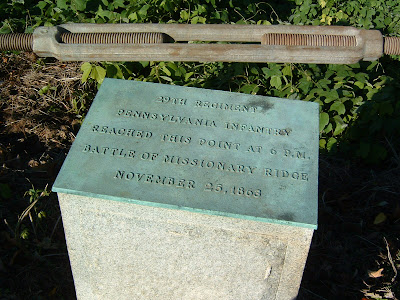 111th Pennsylvania marker
 15th Wisconsin marker
 The 15th Wisconsin marker is next to the stop sign. This intersection gets a fair amount of traffic and I'm surprised a car has not plowed into the marker yet.

 8th Kansas monument. This is where they broke the Confederate lines. Some of the regiment then moved to the left towards tunnel hill while others followed the retreating Confederates due east across the ridge and down the other side.
 As you can see the monument is inside the path of electrical lines.
 11th Michigan marker
 Missouri monument, nearly unreadable. I believe it is for Co. "F" of the 2nd Missouri Light Artillery.
 29th Pennsylvania marker
 111th Pennsylvania marker
 15th Wisconsin marker
 The 15th Wisconsin marker is next to the stop sign. This intersection gets a fair amount of traffic and I'm surprised a car has not plowed into the marker yet.
Subscribe to:
Posts (Atom)


 Posts
Posts

